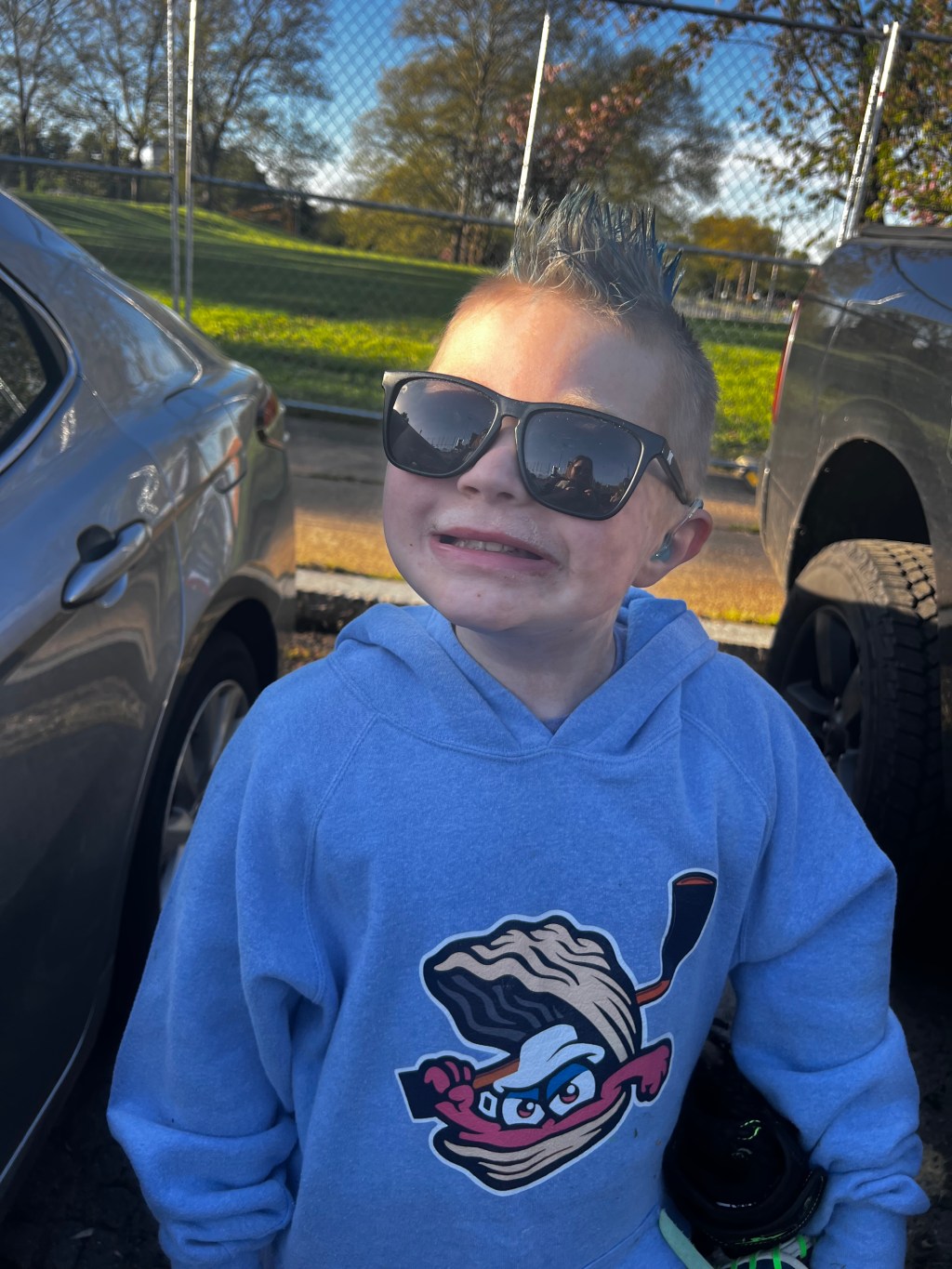
I have always hesitated to share Maxwell’s story in a blunt and direct way. I’ve tried to share it in a way that was soft and palatable. I was worried that the heaviness of his medical conditions would change how people treated him. Because of the way I was raised, I have a fear of appearing as if I am attention seeking or over-dramatic. I never wanted anyone to meet Max with pity or sadness. Considering the why of this blog, to share our story with other people, the best way to do this update is to share exactly what his doctor wrote.
Someday, the pain from Maxwell’s spinal cord still being tethered could interfere with his daily life. We know that someday Max’s hearing, vision and mobility could all decline. We understand that having to accept challenges for Max is different than for other kids. Max’s health situation is a live example of staying right here in this present moment. Our motto has and will continue to be, “Someday things might suck. But right now, it doesn’t suck. So, until it sucks, it doesn’t suck”.
“Until it sucks, it doesn’t suck”. Can you see the t-shirt and water bottles already?
Despite what I am sharing here, Maxwell plays ice hockey, deck hockey, soccer, baseball and anything else he can. He is athletic, determined, playful and competitive. He is a physically strong kid who tires quicker than others but his will and determination carry him to the finish line.
| Max is an 8 year old boy with suspected mosaic disorder – dermatologic diagnosis of epidermal nevus syndrome due to hyper-pigmentation along the lines of Blashko. Has has been followed by Genetics at Boston Children’s (last seen 9/24) and is seen today in the Neurogenetics Clinic for review of prior work up and consideration of additional testing. He came to the appointment with his parents. Maxwell was born at 37 weeks’ gestation to a 37-year-old, G3, P1, SAB 1 mother and 29-year-old father. During the pregnancy the mother was on glyburide and aspirin due to a history of preeclampsia and hypertension. There was gestational diabetes. He had a normal 20-week ultrasound. He was born C-section due to failed vaginal delivery and had a large head at birth. BW was 8 lb 13 oz and he had a brief NICU stay for 2 days due to hypoglycemia and elevated bilirubin which quickly resolved. He failed his newborn hearing screen. Max subsequently was noted to have multiple medical issues as follows; – congenital hearing loss – mixed conductive and SN? Left more than right. Left mod to severe , right borderline It has been stable. -coloboma of the iris bilaterally noted by 6 months of age. He more recently has been noted to have retinal abnormality and has been seen by Dr Fulton in Boston -tethered cord s/p release surgery 2018 and 2019 – noted due to “odd gait” with dragging of one leg and sacral dimple. He is followed by Dr Martin. He has neurogenetic bladder in association with this and does CIC several times daily. He is followed in Urology. There was concern for abnormal echogenicity of the kidneys and ? Duplicated collected system but his last renal ultrasound was read as normal. -undescended testes on one side s/p orchiopexy and inguinal hernia repair left. -he had dysphagia noted late in the first year of life and drinks thickened liquids. -mild developmental delay – he walked at 17 months – no current motor concerns. He has been evaluated in Dev Peds for mild cognitive delay and has had an IEP at school. He is in the 3rd grade. Mom believes prior cognitive testing found FSIQ of low 70s. No concerns about gross or fine motor skills currently. He is very active. -hyper-pigmentation along lines of Blashko – He is followed by Dr Mary Chang who diagnosed Epidermal Nevus syndrome. He also has keratosis pilaris and eczema -He had a normal cardiology eval with echo and EKG normal in 2019. Max had an extensive genetic work up at Connecticut Children’s and Boston Children’s as follows; -microarray normal -CHD7, connexin 26 negative -whole exome sequencing on skin biopsy with reanalysis 6/2024 – negative There was discussion of enrollment in a whole genome study but I don’t believe this was done. PMH: as above. FH: Please see scanned pedigree. He has 2 healthy siblings. PE: Ht 125 cm (4′ 1.21″) | Wt 36.2 kg (79 lb 12.8 oz) | BMI 23.17 kg/m² HC 78%ile Height 10%ile Weight 90%ile Alert and active. He has swirled hyper-pigmentation- very slight elevation, slightly more notable on left side of body than right and more notable on neck/trunk and back. He has keratosis pilaris on his arms. He has iris coloboma, larger and more notable on left side than right. Larger pupil left than right. Chest is clear Cardiac exam is normal with regular rate and rhythm. Abdomen is soft without HSM or masses. Extremities are well perfused. He has 2/3 syndactyly of both feet and toes are square shaped with increased gap between toes 1 and 2. Fleshy fingers. Mental Status: Alert, visually attentive, socially responsive with good eye contact, speech normal for age. Cranial Nerves: Pupils left larger than right with large coloboma, visual fields full, extraocular movements full and conjugated, ffacial movement symmetric, hearing intact to finger rub, palate elevates symmetrically, tongue protrudes in midline. Motor/Reflexes: Normal muscle bulk, tone, and full range of motion. Moves all extremities symmetrically with good power, gait slightly stiff. Reflexes 2 + at biceps,No clonus present, Sensation: Sensation intact to touch Cerebellar: No evidence of dysmetria or ataxia. A/P: Max is an 8 year old boy with multiple medical issues suggestive of a somatic genetic mutation including hyperpigmentation along lines of Blashko, hearing loss left greater than right, coloboma larger on the left than right and more recent diagnosis of retinal dystrophy, tethered cord s/p release with neurogenic bladder, mild cognitive delay/borderline IQ, history of undescended testicle s/p orchiopexy and inguinal hernia repair. He has undergone an extensive genetic work up as outlined above including exome sequencing of skin biopsy with reanalysis in 2024 – all negative. His features fit broadly in to the epidermal nevus syndrome but a specific genetic etiology has not been determined. I will reach out to Dr Sacharow who has followed him in Genetics at BCH – there was talk of enrolling him in a whole genome research study but I don’t believe this was done. We could consider sending this clinically – though again may benefit from testing affected skin site. I will also order a brain MRI which has not been done previously to assess for any vascular or other malformation which can occur with epidermal nevus related syndromes. It was a pleasure to see Max. I will see him back in 6 months. Sincerely, Louisa Kalsner, MD |
 Somewhere In The Middle
Leave a comment